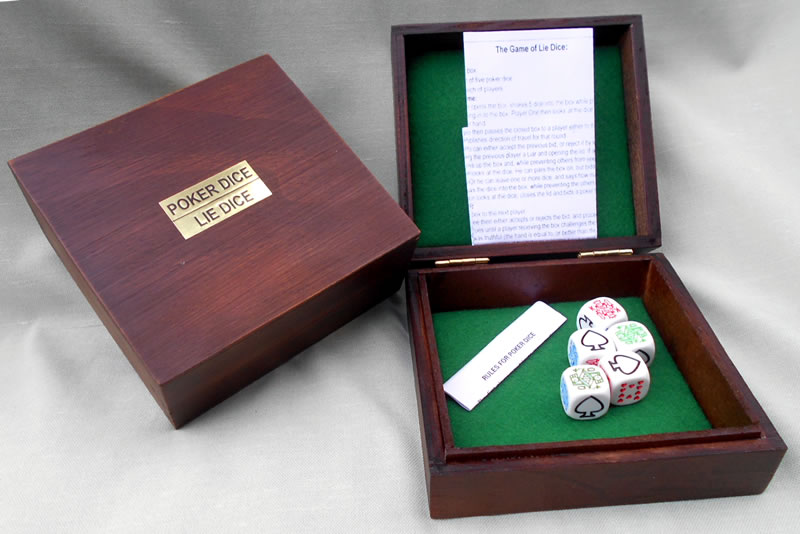
Description
The Game of Lie Dice:
Requirements
• Dice box
• A set of five poker dice
• A bunch of players
To play the Game:
1. Player One opens the box, shakes 5 dice into the box while preventing the others from seeing in to the box. Player One then looks at the dice, closes the lid and bids a poker hand.
2. Player One then passes the closed box to a player either to the right or left which then establishes direction of travel for that round.
3. Player Two can either accept the previous bid, or reject it by leaving the box on the table, calling the previous player a Liar and opening the lid. If accepting the bid, Player Two picks up the box and, while preventing others from seeing into the box, lifts the lid, and looks at the dice. He can pass the box on, but bidding a new (higher) hand. Or he can leave one or more dice, and says how many dice he will throw. He throws the dice into the box, while preventing the others from seeing in to the box. He then looks at the dice, closes the lid and bids a poker hand, higher than the previous bid.
He passes the box to the next player.
4. Player Three then either accepts or rejects the bid, and proceeds as per step 5. This continues until a player receiving the box challenges the hand bid just prior. If the bid was truthful (the hand is equal to, or better than the bid), the challenging player loses a life. If the bid was a lie (the hand is less than the bid), the bidding player loses a life.
6. The player who loses a life restarts the process from step 1.
7. The first player to lose three lives pays a penalty. At this point, all players now have a clean slate (i.e., three lives), and the game can begin anew.
The Details:
1. The bid does not necessarily have to match any dice, be lower/greater than, or equal to what the dice show.
2. Players may specify as many dice as they want in their bid. For example:
• zero [“Junk”]
• one [“one king”]
• two [“a pair of kings”]
• three [“three queens”, or “a pair of aces and a ten”]
• four [“two pair – nines and tens”, or “three aces and a king”]
• five [“four jacks and a ten”, or “full house – aces over queens”]
3. Each bid offered must be greater than the previous bid (if even only by specifying one more die).
4. Blind bidding is legal – players are not required to look in the box prior to or after shaking it.
5. The dice rank as follows, from highest to lowest:
• Ace King Queen Jack 10 9
6. The bids rank as follows, from highest to lowest:
• Five of a kind – any five dice of the same rank. Five of a kind beats four of a kind or any lower bid.
• Four of a kind – any four dice of the same rank. Four of a kind beats a full house or any lower bid.
• Full house – three of a kind and a pair. A full house beats a straight or any lower bid.
• A straight – five dice in sequence. A straight beats three of a kind or any lower bid. There are two possible straights: a high straight (A-K-Q-J-10), and a low straight (K-Q-J-10-9). A high straight beats a low straight.
• Three of a kind – such as three Jacks, with two unmatched dice. This bid beats two pairs or anything lower.
• Two pairs – two dice of one rank, plus two dice of another rank, with an unmatched die. Two pairs beats one pair, or a high die.
• One pair – any two dice of the same rank. One pair beats a high die.
• High die – the rank of this bid is the same as the highest die in the roll. High die beats “Junk”.
• “Junk” – effectively, no bid. This bid may only be made once, by the player opening a round (Player One).
Note: The rank of a bid may be increased by specifying (or increasing the value) of the unmatched dice. For example, four Jacks and a 10 is a higher bid than four Jacks.